





Across Australia, the Early Childhood Education and Care sector is being asked to expand their role in their communities. Once a place of care and education alone, they are increasingly becoming points of connection between children, families, and support services.
Integrated hubs, school-based ECEC, co-located services and tiered supports are all emerging across the sector. Policy is moving in this direction and the evidence is strong. The care and wellbeing for the whole child requires holistic integration of services.
At Stanton Dahl, we have been asking: How does the Early Childhood space itself enable integration to work?
We see architecture as more than a container for services, but rather the structure that allows care continuity, dignity and belonging to unfold. If integration improves wellbeing, spatial design determines whether integration actually works.
Wellbeing as a shared condition
The Early Years Learning Framework speaks of Belonging, Being and Becoming as foundational to early childhood development. Belonging recognises that children exist within families and communities. Being acknowledges the present experience of safety and identity. Becoming looks toward growth and future possibility.
These principles sit within the National Quality Framework, particularly:
- Quality Area 3: Physical Environment
- Quality Area 6: Collaborative partnership with families and communities
- Quality Area 7: Governance and leadership
Taken together, they imply that wellbeing is a relational condition held across people, practices and place. When early learning centres integrate family support services, health services or community programs, they redefine wellbeing as shared. Children thrive when families are supported. Families feel secure when dignity is preserved. And staff collaborate effectively when environments are structured to allow it.
Just as organisational charts map out these elements of integration, they also required spatial resolution.
Threshold Model: A Practical Spatial Framework for Integrated Early Learning
To support centre owners and school leaders thinking about integration, we developed a layered threshold model. Integration works best when space is sequenced, not flattened.
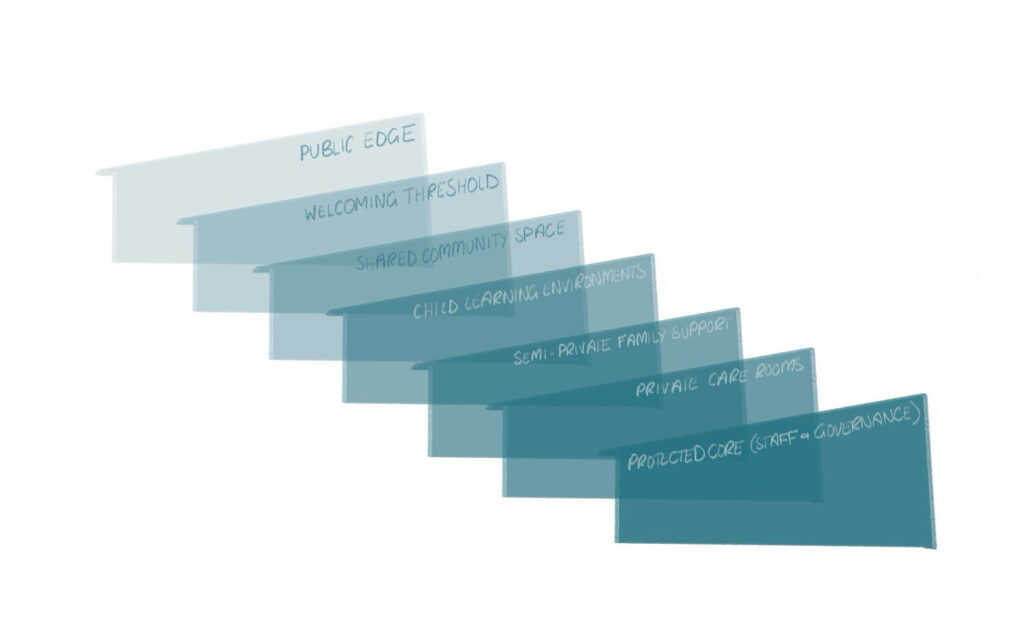
This sequencing resolves key spatial tensions:
Visibility vs Privacy
- Caregivers can see activity without feeling exposed
- Staff can collaborate without breaching confidentiality
- Support services remain accessible but discrete
Child-scaled vs Adult Service Zones
- Children are not positioned inside clinical environments
- Adult services do not dominate early learning spaces
- Both can coexist without undermining the other
Public Threshold vs Protected Care
- Entry is open and generous
- Sensitive services are layered deeper within
- Dignity is preserved through spatial progression
This is spatial choreography.
A Practical Design Checklist
For centre owners and school-based ELC leaders considering future capital works or expansions, we recommend asking:
- Threshold
- Does your front door signal belonging?
- Can a caregiver enter without feeling they are being “sent somewhere”?
- Is there a genuine soft entry moment?
- Layering
- Are child environments clearly defined and protected?
- How does a new family feel navigating and circulating the different zones?Are support services adjacent but not intrusive?
- Is circulation structured to avoid cross-exposure of private conversations?
- Dignity
- Can families access support discreetly?
- Are consultation rooms acoustically secure?
- Do waiting spaces feel relational rather than transactional?
- Staff Integration
- Do educators and allied professionals share collaborative planning space?
- Is the governance core positioned to support integrated practice?
- Does spatial adjacency reinforce partnership?
- Scale
- Is the building scaled to children in the right places?
- Is it scaled to adults where necessary?
- Are transitions between these zones intentional?
Honour, wellbeing and dignity in the built form
At Stanton Dahl, our work across education, community, housing and faith-based environments is shaped by a simple conviction: Space is never neutral. It should honour people. It should support wellbeing. It should preserve dignity.
When early learning centres become hubs of share support, architecture carries significant responsibility. The way thresholds are shaped, rooms are layered and adjacencies are resolved directly influences how families experience care.
Integration is a spatial question.
As you consider your next masterplan, refurbishment or new build, we invite you to reflect:
- Where does belonging begin in your building?
- Can support be accessed without stigma?
- Does your environment protect children while supporting families?
- If integration is your goal, has your space been designed to hold it?
We would welcome the opportunity to explore these questions with you.

 Previous
